2026年6月19日(金)
Summer Night Concert 2026
20:45 開演 シェーンブルン宮殿, 庭園, ウィーン, オーストリア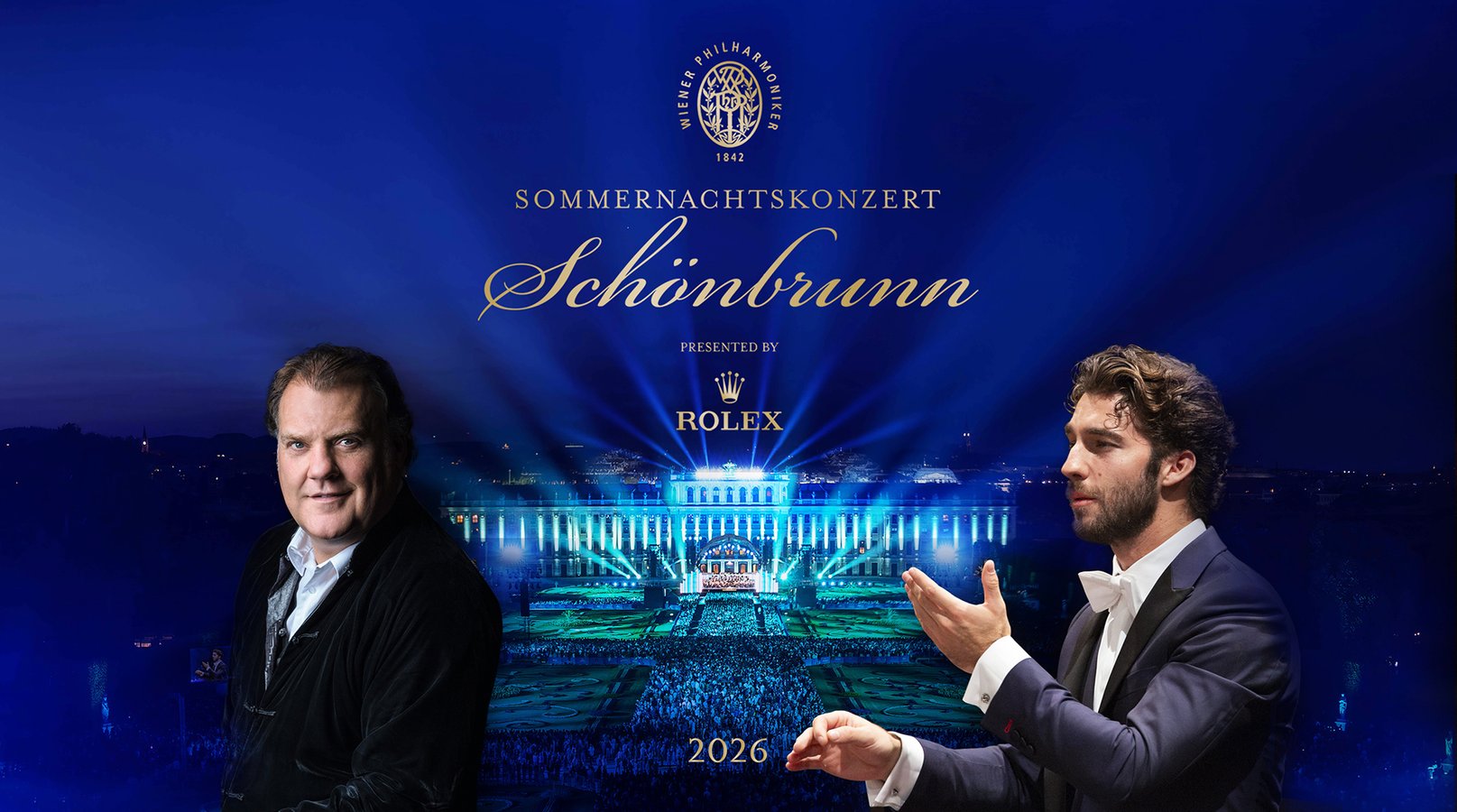
オーケストラ
Wiener Philharmoniker
指揮者
Lorenzo Viotti
バリトン
Sir Bryn Terfel
曲目
Franz von Suppè
Light Cavalry Overture
Arrigo Boito
"Son lo spirito che nega", Arie des Mefistofele aus der Oper „Mefistofele“ (1. Akt)
Giacomo Puccini
Intermezzo from the Opera "Manon Lescaut"
Giuseppe Verdi
„Ehi! paggio!", Arie des Falstaff aus der Oper „Falstaff“ (1. Akt)
Peter Iljitsch Tschaikowsky
Trepak, aus dem Ballett "Der Nussknacker"
Florence Price
Adoration (Orchestrierung Elaine Fine)
Erich Wolfgang Korngold
Straussiana. Polka - Mazurka - Walzer
Richard Wagner
"Abendlich strahlt der Sonne Auge", Auftritt des Wotan aus der Oper "Das Rheingold" (4. Szene)
Jules Massenet
Méditation aus der Oper "Thais" (2. Akt)
Maurice Ravel
Daphnis et Chloé, Suite No. 2
Jerry Bock
„If I were a rich man“, Lied des Tevje aus dem Musical „Fiddler on the roof“
Program Notes
Devils, gods, antiheroes, and a great deal of love
The programme of the 2026 Summer Night Concert offers an exceptional journey through the worlds of opera, operetta and the musical, which are closely intertwined with the realms of ballet, dance and the church. At the conductor’s podium, Lorenzo Viotti will be making his début at the Summer Night Concert, as will the Welsh bass-baritone Sir Bryn Terfel, who has enjoyed a close collaboration with the orchestra in opera and concert performances for several decades.
The concert opens with Franz von Suppè, a representative of Viennese operetta who stood out from his contemporaries not only because of his Dalmatian origins but also through his imaginative overtures. With its references to hussars and the csárdás, Light Cavalry, as the first operetta, will transport us to another region of the Habsburg Monarchy: Hungary. However, the military-themed work, which premièred at Vienna’s Carltheater in 1866, struggled to gain traction on stage. The Habsburg defeat against Prussia, the loss of the remaining Italian territories and the need to renegotiate relations with the Kingdom of Hungary caused public interest to wane – with the exception of the overture, which later even made its way into the stadium of the German Bundesliga football club Eintracht Frankfurt as the goal anthem as well as into Frank Zappa’s song Jesus Thinks You’re A Jerk.
At the same time that the Viennese operetta was becoming established, Arrigo Boito was forging new paths for opera in the young Kingdom of Italy. In Milan, the young Scapigliatura group (“the Disheveled Ones” or “the Unkempt Ones”) rebelled against conservative cultural trends. Boito, who was well-versed in German literature, dared to break new ground in 1868 with his Mefistofele, based on Johann Wolfgang von Goethe’s tragedy Faust, which had previously made its mark primarily on French stages through Hector Berlioz and Charles Gounod. The diabolical title character appears as “the spirit that always denies” with an aria that clothes Goethe’s original work in a boldly dramatic guise and shatters conventions with its partly whistled refrain.
As a pioneer of modern Italian opera, Boito exerted a decisive influence on both the younger and older generations of Italian composers. With his stage works, Giacomo Puccini paved the way for Verismo through his naturalistic depiction of tragic destinies outside the upper social classes. As the unfaithful lover of a wealthy tax collector, Manon Lescaut is arrested and deported to Louisiana, where she dies of thirst in the desert in the arms of her lover Des Grieux, who had accompanied her. In the Intermezzo sinfonico, Puccini recounts Manon’s imprisonment and transfer to Le Havre, siding with his ostracised protagonist.
As a librettist, Boito also inspired Giuseppe Verdi – nearly thirty years his senior – to return to composing after a long creative hiatus, resulting in his two late operas Otello and Falstaff, both based on Shakespeare. In Falstaff – their version of The Merry Wives of Windsor, whose other well-known musical setting was composed by Otto Nicolai, founder of the Wiener Philharmoniker – the librettist and the composer pull out all the stops in their comedic character study of an antihero. When, at the beginning of the opera, the penniless knight Sir John Falstaff writes two identical love letters to two married women in order to gain access to their husbands’ fortunes, all while reflecting on noble honour, Boito puts a light-hearted variation of Mephistopheles’ nihilism into his mouth: “What is honour? Can it accomplish anything? Nothing.”
The trepak is a dance rooted in the culture of Russian and Ukrainian Cossacks, performed in 2/4 time and characterised by spectacular leaps, rhythmic stamping, and crouching steps and hops similar to the kazachok. The trepak first appeared in classical music in 1892 in the second act of Pyotr Ilyich Tchaikovsky’s ballet The Nutcracker. There, in the “Kingdom of Sweets”, it provides a counterpoint to the culinary-inspired character dances of chocolate, coffee, tea and ginger.
Adoration by the African-American composer, pianist, organist and educator Florence Price offers a tranquil contrast to the exuberant dance. Price’s works have gained widespread recognition in recent years following the discovery of numerous manuscripts in her former summer home in Illinois in 2009. Adoration is an organ piece composed in 1951, and its contemplative style evokes a prayer that ends with an “Amen”. The Summer Night Concert will feature Elaine Fine’s arrangement for string orchestra.
Erich Wolfgang Korngold, too, had to find his place in the United States as an emigrant persecuted by the Nazis. The renowned opera composer established his second career in Hollywood through film scores. Just how deeply Korngold remained rooted in his native Vienna is evident in his arrangements of Johann Strauß’s operettas in the post-Romantic style of the 1920s and 1930s, of which A Night in Venice remains a staple of the repertoire to this day. After World War II, Korngold attempted to re-establish himself in Europe as a composer of classical orchestral music, but stylistically he was far removed from the post-war avant-garde. In his Straussiana, composed in 1953, he looks nostalgically from California back towards Vienna by once again turning to Strauß scores: first the Neue Pizzicato-Polka, which had been incorporated into the operetta Fürstin Ninetta as interlude music; then the Polka française Bitte schön! from Cagliostro in Wien, transformed into a mazurka in triple meter; and finally a waltz from the opera Ritter Pásmán, which had been premièred at the Court Opera in 1892 by members of the Wiener Philharmoniker. Korngold’s dazzling orchestral colours are characterised by additional percussion instruments, piano and harp, the expanded use of woodwinds and the sobbing swells of the strings. Korngold had conducted the Wiener Philharmoniker on several occasions during the interwar period, and the orchestra will now pay tribute to him by performing Straussiana for the first time.
With Richard Wagner’s Das Rheingold, the first part of his Der Ring des Nibelungen tetralogy, the Wiener Philharmoniker commemorates the cycle’s world première in Bayreuth in 1876, which marked the opening of the Festspielhaus on the “Green Hill”. The Wiener Philharmoniker has direct ties to Bayreuth through Hans Richter, the conductor of the première, who played the horn in the Wiener Philharmoniker from 1862 to 1866, and then conducted the orchestra’s subscription concerts from 1875 to 1898. Musicians from the orchestra’s ranks also played in the Bayreuth Festival Orchestra. “The sunlight shines at evening; in glorious radiance the castle stands resplendent,” sings Wotan, father of the gods, before the gods enter Valhalla, newly built through a breach of contract. The radiant splendour, however, will fade dramatically in the three subsequent parts of the Ring cycle.
On the French side, in contrast to Wagner, stood the immensely prolific Jules Massenet, whose operas Manon and Werther establish thematic links to both Puccini and Boito. On the other hand, Thaïs, premièred in 1894, clearly embodies the spirit of the fin de siècle: in early Christian Egypt, the monk Athanaël attempts to convert the actress and courtesan Thaïs to a chaste life. Thaïs meditates on this to the sound of the violin, while the moralising preacher sleeps outside her house – or perhaps does not sleep at all… The scene takes place behind a closed curtain, yet the undeniably sentimental music encourages the audience all the more explicitly to imagine the eroticism underlying this meditation on renunciation. With the “Méditation”, an instrumental work by Massenet will appear on a Wiener Philharmoniker concert programme for the first time in over one hundred years.
Following these pieces of evening and night music, Maurice Ravel’s Second Orchestral Suite, which he compiled from his ballet Daphnis et Chloé in 1913, opens with a “Daybreak”. The one-act ballet is based on an ancient Greek romance by Longus and is set on the island of Lesbos. To enchantingly magical sounds, the shepherd Daphnis awakens and is reunited with his beloved. The shepherdess Chloé had previously been abducted by pirates. The music then heralds the lovers’ reunion. In the following “Pantomime”, Ravel depicts the intense emotions between the lovers, whom he transforms into the mythical figures of Pan and Syrinx. The suite culminates in the concluding “General Dance” with near-ecstatic intensity. During an evening celebration, Daphnis and Chloé are united – a scenario perfectly suited to the setting of the Summer Night Concert in the Schönbrunn Palace Gardens.
Jerry Bock’s musical Fiddler on the Roof, with lyrics by Sheldon Harnick, premièred on Broadway in 1964; it draws on stories by Sholem Aleichem written between 1894 and 1914, and was adapted for the stage by Joseph Stein. The story centres on episodes from the life of the Jewish milkman Tevye in the fictional Russian shtetl of Anatevka, which evoke Aleichem’s own experiences in “Yehupetz” – as he called the Ukrainian capital, Kyiv. In “If I Were a Rich Man,” Tevye turns to God and wishes for enough money so that he can marry off his three daughters without financial worries. Throughout the musical, Tevye is repeatedly confronted with existential questions, yet his love for his family and the people around him, his wisdom, and his humour give him the strength to overcome all adversity.
Silvia Kargl / Friedemann Pestel
Translation: John Moraitis